Tuesday, 28 May 2013

Chapter 6, Part 3 - Harrison Ford: From Artisan to Artist


As was his custom on his other films, Ford did most of his own stunts for Blade Runner. One memorable scene had him clinging precariously to a ledge, hundreds of storeys above the teeming streets.

‘We were using a 65mm Mitchell camera,’ explained effects man David Dryer, ‘which weighed about 75 pounds. With that kind of weight cantilevered out over Ford there was always the chance that the camera would break a casting and come right down on him. So we rigged a special plate and support to get the camera actually looking back down on itself.’

It was Rutger Hauer’s job to haul Ford up onto the roof. ‘Harrison didn’t want to fall down that twenty foot drop, or whatever it was. So he was hanging there, with a wire for support, but it was still kind of tough to get him up.’

But Ford was dismissive of the danger involved. ‘That shot where I’m hanging from the girder ... well, god knows, I’m not hanging 30 storeys above the ground there. Not only am I not hanging from the girder, I’ve got a safety belt on and a wire that’s got me clipped to the bottom of the girder ... and I’m acting like I’m hanging from a girder, from the contortion of my face, the sweat of my brow. That’s all acting ... wonderful acting!’ But on a more serious note Ford is careful to draw a clear distinction between what he does and ‘real’ stunts. ‘What I’ve done in Raiders of the Lost Ark and Blade Runner is “physical acting”. Stunts are falling off a tall building or crashing a car. Something you’re silly enough to think isn’t going to hurt the next day.’


Ford claims he wasn't really dangling from a girder by his fingertips
30 storeys above the ground ... but I don't believe him for a second.
Meanwhile, rumours abounded that Ford had drastically altered his appearance for the movie, one American newspaper even claiming Ford played Deckard with a shaved head. ‘The crewcut was my idea,’ said Ford. ‘And I had to talk Ridley into it, because he was afraid that it might make me less ... gorgeous. The haircut couldn’t be done unless Ridley was there. It took about four hours to get it. With long pauses for consideration by Ridley. My ambition was always to get it right down. Real short. I wanted to give the impression of a character who has given upon himself, was unconscious of his appearance and had lost, to a large degree, that ego that keeps us all doing things like combing our hair, brushing our teeth and all of that. I thought it was important to suggest that and change my appearance in some way. I think it’s more interesting for an audience, even if they know right away who it is. They don’t have the same expectation of you if you don’t look the same. It gives you a foot forward.

‘And one of the other things that drives me nuts when doing a four month shooting schedule is when someone is fiddling with your hair between every shot. I just can’t stand that. It just drives me nuts. If I could have short hair on every film ... I mean, some of my best friends are hairdressers, but it does drive me nuts. The first thing I do after a film where I have long hair is cut it all off.’ The beard was also Ford’s idea. ‘The first day of Blade Runner, I’m shaved. When the events begin to take over my life, it hardly seems a proper time to shave ... when things are going the way they are in Blade Runner, there doesn’t seem time for a bath and a shave. I think that kind of detail goes to make up the character. I try not to lose sight of those little things.’


An early continuity pic of Ford ... here his hair
is longer than it appeared in the final movie.
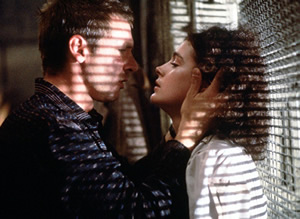
By this time, Ford had had a chance to think through Deckard’s relationship with Rachael. ‘It’s clear that Deckard doesn’t think very much about women at all,’ he told the author of Blade Runner souvenir magazine. ‘He’s the type of guy that would see them occasionally but not have any use for them around the house. He has a wife and child but they seem to have gone in search of a better life. Deckard acknowledges on Rachael’s first appearance that she is attractive. But then she becomes a puzzle and, when he figures out she is a replicant, he seems to have no further use for her. He sees Rachael as a zero. But her display of emotion, even though he knows it’s false, implanted, pulls him out of his despair. As he begins to become involved with her, he is forced to confront what is really going on around him.’

THE RELEASE

Director Ridley Scott called ‘cut!’ for the last time on Blade Runner during the second week of July, 1981. The production was already over-schedule and over-budget. The filmmakers busied themselves with such vital post-production activities as editing, dubbing and adding the excellent Vangelis music. The following January, the first of the Blade Runner trailers was released in America. It featured scenes from the movie under the music of the Inkspots, enhancing the idea of Blade Runner as a 1940s pastiche.

A rough cut of the film previewed in Denver, Colorado. The feedback from that screening indicated the fans were unhappy with the abrupt ending of Deckard and Rachael stepping into the lift and the doors slamming shut behind them.

‘Fortunately, we had also shot an alternative ending, with Deckard and Rachael leaving the city together in a Spinner, heading towards the unpolluted Northwest,’ said Scott. Also at this stage, there was no Harrison Ford voice-over to explain the more ambiguous scenes in the film. I was lucky enough to see this version at an early preview in London around March, 1982, and feel this ‘first draft’ to be far superior to both the theatrical release cut and the later ‘Director’s Cut’ released on VHS video.

When the film came out on June 25, 1982 in America, the 1940s look and the laconic (some would say, ‘bored’) narration was singled out by the critics as the chief target for attack. Ford was a little defensive about such comments. ‘I thought it had the makings of a very original film,’ he said. ‘It was no ambition of mine to play the character like a Forties Bogart figure, but it was always on Ridley’s mind. It was always my hope that there wouldn’t be a voice-over, that we wouldn’t need one. I thought the character needed to be a representation of a certain type of physical environment, the result of that kind of life. The voice-over was always Ridley’s idea, from the beginning.’

Scott was a little more philosophical. ‘We never addressed the problem of the voice-over early enough,’ he told me. ‘I wanted the voice-over from the beginning. The screenplay was written with a voice-over.’ But that wasn’t the voice-over that appeared in the finished film. And Scott was far from happy with the end result. ‘The voice-over is an essential part of the Marlowe-type character of Deckard and also to a degree helps clarification. One of the most interesting aspects of Apocalypse Now was the voice-over. It was incredible. I think Coppola went on for nearly six months trying to get that right. I think, with hindsight, I would have re-done the voice-over in Blade Runner, and I think Harrison would as well.’

As it turned out, the final narration was no masterpiece and it jarred against the other aspects of the production. Of particular note was the corny speech over the scene in which replicant Roy Batty dies. Ford’s tired voice proclaims. ‘I don’t know why he saved my life. Maybe in those last moments he loved life more than he ever had before. Not just his life. Anybody’s life. My life. All he’d wanted were the same answers the rest of us want. Where do I come from? Where am I going? How long have it got? All I could do was sit there and watch him die.’ Raymond Chandler, it’s not.


Ridley Scott directs Ford during the final showdown
with Roy Batty (Rutger Hauer).
Almost predictably, the reviews weren’t good.

Playboy’s Bruce Williamson thought Blade Runner was a ‘major disappointment’ despite ‘smashing production values and fine actors’ and summed up the movie saying, ‘by the time Ford and Hauer face off for their climactic showdown, Blade Runner had grown dull – a simple case of Philip Marlowe meets Frankenstein.’

The British trade publication Screen International felt ‘the special effects dominate the film while the plot and characters fade into the background,’ and pointed out that ‘in spite of his voice-over ironies, Rick Deckard is no Philip Marlowe.’

The American trade bible Variety said that ‘Ford’s frequent inertia mutes the detective angle of the story which is couched in some hard-boiled Chandleresque narration and in the long run proves to be the weakest aspect of the pic.’

Some critics believed that the level of violence in Blade Runner was more explicit than was necessary. Ford countered this in his usual eloquent style. ‘There’s a really unfortunate and ill-advised attitude to the violence in the film. I am conscious of violence in a film. I abhor it when it is used for the sake of itself. I was anxious to make sure this character represented the abhorrence of violence. And he does. He wanted to get out of the police force because he couldn’t stand the killing. After every incident of having to kill someone, the character’s revulsion is clear. And, ironically, he is not killing human beings. That’s what the thematic backbone of the film is. They’re not really human beings. And yet, his empathy with something that looks like a human being – which is later to lead him into a romance with a machine affects him.’

In spite of the negative criticism of the film, Ford’s performance was praised. Scriptwriter David Peoples was enthusiastic about Ford’s portrayal of Rick Deckard. ‘Harrison is an absolutely magnificent actor,’ he commented. ‘He’s amazing. He’s like the great old guys. He becomes Deckard. I mean, you don’t see him act like Deckard, he is Deckard and Deckard is different from Han Solo and entirely different from Indiana Jones. In Blade Runner he’s a seething guy with a lot inside him. He’s a guy who’s got a lot of problems, who’s holding a lot in, and Harrison does it brilliantly.’

Science fiction author and friend of Philip K. Dick’s, Norman Spinrad was more restrained about Ford’s performance. ‘Harrison Ford is fine in the rather undemanding role of Deckard,’ a comment that seems to me to be sniffy and dismissive.

In my view Blade Runner remains probably the most literate science fiction film ever made. Ford’s performance is a masterpiece of understatement and contributed mightily to the film’s artistic success. Ford himself has spoken critically of his involvement in the film, stating that he’s very unhappy with Ridley Scott’s later claims that Deckard was always intended to be a replicant. However, I never got that Deckard was any kind of replicant from the movie in any of its cuts, just that the momentary doubt about his own humanity the character experiences is enough to finally convince Deckard that replicants are worth no less than human beings.


Some people thought this scene indicated that Deckard
was a replicant because his eyes glowed in the same
way as Rachel's ... I'd want more evidence than that.
Yet Blade Runner was an extremely important step in Ford’s career. It was his first opportunity to show what he could do as a serious actor. It was becoming obvious that Ford was a far better actor than his Star Wars and Raiders vehicles allowed audiences to see. But further expeditions into the area of serious acting would have to wait. Already the date for the beginning of principal photography of the third part of the Star Wars saga was approaching. It was almost time for Ford to return to the worlds of robots and rayguns as Han Solo in Return of the Jedi. But not before he’d rested up a while. ‘It would take an Act of Congress to get me to work before Jedi,’ he said, ‘I haven’t had six months with the kids for a long time.’

But Ford would be back at work quicker than he expected. Melissa had been around on set much of the time during the filming of Raiders, working with Spielberg on the script for E.T. During the filming of E.T., Spielberg had Melissa work with the child actors, rehearsing their scenes. It was inevitable that Ford would end up with a role in the movie. Spielberg also persuaded Melissa to play the part of the nurse who takes the “drunk” Elliot to the principal (played by Ford). As with most of the other adults in the film, their faces would not be seen. But nervous Melissa’s hands trembled so badly during her scene she pleaded with Spielberg to scrap the footage. So not for the first time in his career one of Ford’s performances was consigned to the cutting room floor.

Saturday, 18 May 2013

Chapter 6, Part 2 - Harrison Ford: From Artisan to Artist


THE CASTING

Harrison Ford’s involvement in Blade Runner goes back further than that of David Peoples. ‘They first asked me about Blade Runner,’ said Harrison Ford, ‘when I was doing ... hmm, Empire, I guess – I have such a bad memory. They were going to make it in London at that point in their plans and I said, “Well, thank you very much, gentlemen, but I don’t want to work in London any more. I want to go home.” Five of my last eight films have been made in London. When they came back to me, it turned out that they couldn’t put it together in London for some reason.’ That reason was intertwined with the collapse of Filmways and the involvement of Tandem Productions and The Ladd Company.

However, according to the book Harrison Ford: Reluctant Hero, Scott had approached Ford during the filming of Empire in 1978, not about Blade Runner, but about Alien, to play the role of Captain Dallas. Ford turned it down as he didn’t want to play another space pilot and the role went to Tom Skerrit. Scott’s approach to Ford about Blade Runner was during the filming of Raiders in 1980.


Hard to believe now that anyone other than Ford could
have played Deckard, but the producers also approached
Dustin Hoffman
I asked Associate Producer Ivor Powell to explain the ins and outs of the move from London to LA. ‘After getting Filmways in as the major and the distributor, the next problem was how to shoot the film. Despite all the location scouting we did, there was no one place that had the concentration of architecture that was right. As always, with a film like Blade Runner, it comes down to how you are going to crack the script, how you’re actually going to make it work, how the logistics are going to work and how they are going to work within a price. The budget was gradually being pushed up and Filmways, I guess, were being carried screamingly along with it, and though we were unaware of it at the time, they were having tremendous cash-flow problems. They believed in the project, but I don’t think they had the money for a twenty million dollar movie. The budget had gone from about twelve or thirteen million dollars, which was totally impractical, right up to twenty million plus. Finally, Filmways collapsed and Michael Deeley, very cleverly I think, turned the film around to Tandem Productions (the company of Jerry Perenchio and Bud Yorkin) and The Ladd Company in a very short space of time, though we went through a terrible hiatus where we were trying to hold the crew together. The directors’ strike was looming for later that year. We knew if we didn’t start the movie by a certain date, we would never start at all. It was one of those pictures that you knew that if it didn’t get made then, it would never get made at all. It wasn’t every director’s cup of tea. Finally, the cash-flow started and we got off. We had, at that time, attempted to do a budget. I’d done a quick budget, which had come in at seventeen or eighteen million dollars, if we were making the picture in England. But if we’d made the move to England, it would have been too late to beat the director’s strike, which ironically never happened anyway. So for that, and some other reasons, we made the movie there, at the Burbank Studios.’

With the production base re-located to Hollywood, Harrison Ford once more became available for the leading role as Rick Deckard, blade runner. But for many of Ford’s fans, Blade Runner was a radical departure from the kind of film that had endeared their hero to them. Ford was following his oft-stated intention to avoid type-casting and ensure that each of his roles was sufficiently different from the last.


Ford almost didn't sign for Blade Runner because it was originally
scheduled to be filmed in the UK and Harrison didn't want to make
 another movie in Britain right after Star Ward and Raiders
Ford was finally signed for Blade Runner while the finishing touches were being put on Raiders of the Lost Ark. And, as with Raiders, Ford was not the filmmakers’ first choice for Deckard. I asked Ivor Powell why Harrison Ford had been picked for the role. ‘By popular demand, really,’ said Powell. Raiders of the Lost Ark hadn’t come out then, so we didn’t know if it was going to do well. At one time, we were even talking to Dustin Hoffman, and that would have been a totally different picture. Dustin is not a macho character and he asked Ridley, “Why the hell do you want me to play this macho character?”

‘Ridley was searching for more than just a superficial, macho film,’ continued Powell. ‘He wanted a real character in there, and Dustin, as I understand it, put forward some wonderful ideas. But it wasn’t the film we were talking about making. Finally, I think it just came down to the fact that Harrison fitted the bill.’

Ridley Scott also told me that, as far as he was concerned, Harrison Ford was the man for the job. ‘He has a very unusual quality that shines through in two pictures, The Conversation and Apocalypse Now. It’s a strange, slightly sinister, side. Very low-key and sombre. Almost a different Harrison Ford. Very dangerous. It fitted the nature of both Deckard and the film very well. The only other actor we saw for the part was Dustin Hoffman. He was looking for a different kind of movie. But, god knows, I’d like to work with Hoffman some day. After things fell through there, we went straight to Harrison. He’d been under consideration from the beginning.’

And at the beginning, Ford seemed pleased to be involved in the project. ‘I’m preparing to start work on Blade Runner,’ he told an American fan magazine, shortly before Raiders opened. ‘I’m sure I was considered for the film as a result of Star Wars, just as Ridley (Scott) proved his capabilities in this genre with Alien.

‘I can’t complain so far. Star Wars, Empire, Raiders and Blade Runner are classy, high- quality melodramas, not pot-boilers. They all contain currents of intelligence and morality, and are handled with taste. I’m looking forward to Blade Runner. I think I can give it an aspect that will set it apart from Raiders or Star Wars or anything else I’ve done.’

And while on a trip to Britain to promote Raiders of the Lost Ark, Ford had apparently brought his enthusiasm for Blade Runner with him. As he told the British magazine, Films, ‘Blade Runner is an important step towards more serious roles. And I think it will be a very commercial film because of its unique vision. But I was serious about it because of the people involved and was happy to find out that Ridley was interested in developing the density of the characters as well. I felt that we could work together to present a character who was interesting and very different to anything else I’ve done until now.’

Ford and Scott laboured long and hard to achieve something they could be proud of. ‘We have a lot of discussions about scenes,’ said Ford during filming, ‘but not about motivation. I don’t ask him what my motivations are and he doesn’t ask me what they are. The discussions are usually about practical matters – what we’re trying to get out of a scene, what the obligations are on him as master of the story and me as the character. Then we look for common ground to accomplish the story points and the character points at the same time. And sometimes that’s done without any discussion at all, and sometimes we discuss all hell out of it!’


Ridley directs Ford in the cut scene where Deckard visits the
injured blade runner Holden, who's been put in a ventilator
by Leon (Brion James).
This process was underlined by Ridley Scott. ‘There is always a period of rehearsals before the film, and I at least try to get a couple of weeks for casting and reading through the script. I usually take a certain amount of time and tell the actors about the overall film, not just about their particular parts. It’s usually a lengthy process, but then it is worth it because they know how they sit, how they figure within the overall piece. It is very important that they understand the entire thing.’

Ford was also aware that the characters must be clearly defined before the first foot of film ran through the camera. ‘Ultimately it is the actor who has to perform the act and commit it to film. So, while a director’s job is incredibly complicated and difficult, there are elements that are never resolved – how a prop should work, whether the character carries his gun here or carries it there. These may be simple little details, but they are only decided when somebody gets a strong attitude about things and begins to form a point of view. The character Deckard does finally. He begins to develop a point of view about the circumstances around him.’

Yet for all this there seemed to be a fundamental difference between Deckard as Ridley Scott saw him and the character as envisaged by Ford, Scott’s Deckard was apparent to the director as far back as the Hampton Fancher versions of the script. ‘It started to emerge for me,’ said Scott, ‘that Deckard was a kind of Philip Marlowe character, which is an obvious comparison. Harrison figured he should go for utter reality, almost like de Niro’s Travis Bickle in Taxi Driver.’ Ford himself saw Deckard as, ‘... a reluctant detective who dresses like a middle-aged Elvis Costello. He’s a skilled investigator, an expert in his field, but he’s a little out of practice when the movie opens. He’s lost his motor drive. Exterminating people, even non-human ones, is not something he likes to do, and he’s not comfortable with authority. He’s very tough, but he’s no match for a top-of-the-line replicant.’

Tough though Deckard may have been, he didn’t seem to be quite tough enough to resist the aspect of Chandler-esque pastiche that was creeping into the movie. Under Scott’s direction, Blade Runner seemed to be taking shape as a kind of homage to the great black-and-white noir movies of the Forties. As the film’s director of photography, Jordan Cronenweath, told American Cinematographer, ‘Ridley felt the style of photography in Citizen Kane (1940) most closely approached the look he wanted for Blade Runner. This included, among other things, high contrast, unusual camera angles and the use of shafts of light.’ All the film lacked at this stage was a punchy voice-over narration delivered in the kind of lazy drawl made famous by Humphrey Bogart. ‘The generation of the idea of a voice-over came very quickly,’ said Scott. ‘Eventually a screenplay was written with a voice- over very much in mind.’ Ford wasn’t happy at the prospect of a voice-over narration, but for the time being kept his counsel. There was still the problem of being able to satisfy the requirements of the script without compromising his own goals and principles.

‘My object,’ Ford told an American fan magazine, ‘every time out of the gate is to contrast the public’s last known impression of me. So, with Blade Runner, I’m working against Raiders of the Lost Ark. They originally wanted Deckard to wear a big felt hat. I told them I had just finished wearing one in Raiders, so we changed that.’

Despite evidence to the contrary, Ford felt that the science fiction content of Blade Runner was minimal. ‘I wouldn’t call Blade Runner science fiction,’ he said, ‘because it’s much different from the public’s conception of sf-based on movies they’ve seen in the past.’ Granted, but Star Wars was actually less worthy of the tag Science Fiction than Blade Runner. ‘There are special effects in it,’ he continued, ‘but they’re kind of throwaways. From a technical point of view, Blade Runner is not an effects film, but I’m sure Doug (Trumbull)’s work will add a great deal to the story.’

And even at this early stage, Ford was aware of the film’s noir potential. As he told the reporter of Movie Guide, ‘Blade Runner is a big city detective story, the kind Raymond Chandler might have written, but it takes place in the future. It’s realistic and gritty and takes place entirely on Earth.’

Still, for all the confusion over what Blade Runner and Deckard were all about, Ford was enjoying working with Scott. At least for the time being. ‘Ridley’s very particular and demanding in all elements of the production. I knew he was a great visual stylist, but I was glad to find depth and subtlety of character.’


THE FILMING

The filming of Blade Runner finally got under way on March 9, 1981, after a year of preproduction planning and an additional fourteen weeks of constructing and dressing sets. The project was already running three months behind schedule.

Actual locations, both in the United States and in Europe, had been considered by the film’s producer, Michael Deeley. But finally, the idea of location filming had proved both impractible and undesirable. The production team were happy to settle for shooting the exteriors on the Warner Brothers New York street set, which had been used for such earlier detective yarns as The Maltese Falcon (1941) and The Big Sleep (1946) as well as more recent fare like 1982’s Annie.

Industrial designer Syd Mead and Blade Runner’s production designer Lawrence Paull had been hard at work for twelve months creating the backdrop against which the drama would be played. The cast had been assembled and carefully coached in the lore of Blade Runner. The on-set smoke machine was switched on. The real work could begin.

Most of the action in the movie takes place at night. This meant the cast and crew knuckling down to a gruelling, hours-of-darkness shooting schedule. Lunch was called at midnight and the ‘day’s’ work ended at four or five in the morning. Scott and his key cast and crew members had to survive on an average of four hours of sleep a night, which prevented the kind of family atmosphere Ford had been used to on the Lucas films.

Unlike Lucas, who delegated many of his responsibilities as a filmmaker, Scott preferred to be personally involved in every aspect of the process. Reports filtered through to the trade publications that Ford and Scott weren’t getting along. These reports hinted that Ford was unhappy with Scott’s attention to the mechanics of film-making, a fascination that ran to the extent of Scott operating his own camera during key scenes, a charge Ford denied. ‘It was no big bone of contention between us,’ said Ford. ‘I don’t think he ever got around that problem. He just learned to accommodate the reality. Ridley was able to shoot a few things he really wanted to. And he’s very good. Especially with the hand-held camera. I think there’s quite a few shots in the film with Scott operating his hand-held camera. He likes to watch the performance through the lens. As an actor, I’m glad he wasn’t able to do that all the time. I think it’s better to have his attention on other things. He knows that’s the way I feel. I think that when a director is looking through the camera, he’s watching the edges to be sure where everything is. I want a director to be helping me with a whole scene, the performance. It’s not that this isn’t possible, or that Ridley hasn’t done it before ... and very well.’

Sean Young has reportedly said that Ford was difficult
to connect to on a personal level.
Ford kept himself pretty much to himself during the seventeen weeks of shooting. His co-star Sean Young would have welcomed more collaboration between them. ‘I think Harrison is probably an all-or-nothing type of person and he can’t really relate to other cast members full out, because he feels he might become too wrapped up, and by being friendlier with the crew, he can avoid that whole mess.’

Rutger Hauer was less open in his views on working with Ford. ‘I only had two moments in the film with Ford,’ he said. ‘I didn’t work that long with him, but he was fine. Our scenes were very clearly written in the script. I didn’t feel there was a problem of communication because we didn’t have to talk about it. It was just a matter of doing it without getting hurt.’

Next: The stunts and the press reaction to Blade Runner

Sunday, 7 April 2013

Chapter 6, Part 1 - Harrison Ford: From Artisan to Artist


‘Harrison has an immense understanding of the entire movie-making process. You can’t fool him. He always knows exactly what is happening. His contributions were tremendous, on a story level as well as to his own character. He brought many ideas to me. In fact, it got bloody embarrassing. They were so good there was no way I could wriggle out of using them.’ Ridley Scott, director of Blade Runner


The release of Blade Runner in May, 1982 (September, 1982 in Britain) marked a definite attempt by Harrison Ford to change his image. The fan-following built up by such light entertainment vehicles as the Star Wars pictures and Raiders of the Lost Ark were puzzled by the singular lack of humour in Ford’s performance. So much so that they stayed away in droves. Blade Runner was not initially a commercial success.


Ford fans were puzzled by the lack of humour
in the actor's
Blade Runner performance.
But Blade Runner was perhaps Ford’s most important film up to that point. Certainly, it was his first opportunity to sustain an Acting performance in a starring role. The insight and depth he brought to the character of Rick Deckard showed that Ford was capable of far more than the wisecracking characterisations of Han Solo and Indiana Jones would lead audiences to suspect.

More than that, the backdrop against which the drama of Blade Runner was played out, although futuristic, was grittier and more realistic than the fantastic environments of Indy and Solo.

IN THE BEGINNING WAS THE WORD

No matter how skilled a film’s performers and technicians are, unless the blueprint from which they work – the script – is tightly crafted, the final movie will suffer as a result. Most movie people agree that just about all the problems encountered during the shooting of a film can be traced back to difficulties left unresolved by the scriptwriter – yet when everything goes swimmingly, it’s the director who gets all the credit.

The script of Blade Runner was based, loosely, on the novel Do Androids Dream of Electric Sheep? by respected science fiction author, the late Philip K. Dick, who died tragically on March 2nd, 1982, shortly before the completed film of Blade Runner was released.

No, it's not real ... but don't you wish it was?
The need for the script to be ‘right’ is so universally recognised by filmmakers that it often takes longer to produce a screenplay that everyone is satisfied with than it does to shoot the actual film. Blade Runner is no exception. Work began on the transfer of Dick’s story to the screen almost a decade before the film was released.
‘It all began years ago,’ Dick told Starlog. ‘Martin Scorsese and Jay Cocks were both interested in Androids, but they didn’t option (purchase the film rights to) it. That was the first movie interest in any property (story) of mine. Then later, Herb Jaffe optioned it and Robert Jaffe did a screenplay back about 1973. The screenplay was sent to me and it was so crude that I didn’t understand that it was actually the shooting script. I thought it was a rough. I wrote to them and asked if they would like me to do the shooting script, at which point, Robert Jaffe flew down here to Orange County. I said to him then that it was so bad that I wanted to know if he wanted me to beat him up there at the airport or wait until we got to my apartment.’

The first scene of Blade Runner opens with this arresting visual ...
The Jaffes made little progress with their attempts to put Do Androids Dream of Electric Sheep? on the big screen. But the Jaffes weren’t the only film folk interested in the project. Some time in 1974, Hampton Fancher approached Dick with a view to obtaining the film rights to the novel, but as the rights still rested with the Jaffes, Dick was unenthusiastic. Then, in 1977, the Jaffes let their option on the film rights lapse and within a year, Fancher and his partner Brian Kelly found themselves in possession of the movie rights for Dick’s novel.
Kelly approached Michael Deeley, Oscar winning producer of The Deer Hunter with a view to raising finance for further development, but the reception was cool. Deeley felt that there would be too many problems involved in translating Dick’s complicated story to the big screen. Nevertheless, Kelly and Fancher persevered. Fancher produced an eight- page outline for the film which so impressed Deeley that he encouraged the partners to come up with a full script. ‘I hadn’t ever intended to write the screenplay myself,’ Fancher recalled, ‘but I was convinced that this was the only way to get the project off the ground.’
‘Lord knows,’ commented Dick, perhaps uncharitably, ‘I didn’t think much of his screenplay.’ But despite Dick’s reservations, Kelly and Fancher took their script to Deeley once again. ‘He loved it,’ said Fancher.
Deeley began to hawk the script around the production companies in Film City. ‘People were interested,’ said Fancher, ‘but they wanted changes. They’d want a happy ending or they’d want something else changed. It was pretty precarious there for a while. I think there were about four or five drafts written before Ridley Scott came into it. When Ridley came in that sort of wrapped it up because of the Alien reputation. That’s what it needed for the studio to get down to business with it.’ On the strength of Ridley Scott’s participation, Michael Deeley had put together a deal with Filmways. At this point the title of the project had changed from Do Androids Dream of Electric Sheep? to The Android.


The smarmy blade runner Holder (Morgan Paull)
runs the Voigt-Kampff test on Leon
At the time Scott was approached to direct Blade Runner, he was scheduled to helm Dino De Laurentis’ multi-million dollar adaptation of the best-selling series of Dune novels by Frank Herbert. But delays in the production made it possible for Scott to squeeze Blade Runner in before beginning work on Dune. (For the record, Dune was later filmed by the team of director David Lynch and cinematographer Freddie Francis).
What was it about the script that convinced Ridley Scott to take on the project? ‘What appealed to me, having just done Alien which was very interesting, was the involvement in just developing that future environment further. I love that whole process, almost as much as any other part of movie making. I just didn’t want to step off onto ordinary ground again. What I felt was great about the script was that it was dealing with the near future. It had to be a familiar city, which it is. A lot of aspects of that city are familiar right now. In fact, a lot of people who will see the film, will experience that kind of future themselves. I also liked the aspect that there was a real character in there, rather than a two-dimensional cardboard character, which happens too often with science fiction films. Because the film is usually dominated by a monster or event the characters do, essentially, take second place.’
After Ridley Scott was signed to direct, a major revision of the script, by now called Dangerous Days, began. Initially, Fancher was resistant to some of the changes proposed. And as a co-owner of the project, Fancher was in a position to dig his heels in. But pressure to alter portions of the script became so great that Fancher realised the only way out of the situation was to bring in another writer.
Enter: David Peoples.
As Fancher remarked later, ‘I was surprised when I got Peoples’ script. Those things that Ridley had wanted that I thought couldn’t be integrated into the script had been rendered by Peoples in ways that were original, tight and admirable. I really liked it. But we never actually collaborated. He came in on very short notice and he had a lot of work to do, but he did it very fast and very well.’
Peoples had been brought into the project during November 1980. Shooting was still several months away. ‘I read the script,’ said Peoples, ‘and immediately felt that it was so good that I was disappointed, because when they came to have a meeting I told them I couldn’t make it any better. It was a terrific script. I don’t know which ones Phil Dick read that he didn’t like, but certainly the one I read was absolutely brilliant. And that was the one I worked from to make the changes Ridley wanted, to make it more his vision.’


Ridley Scott directs extras in a Los Angeles street scene.
Throughout this process of re-writing, Ridley Scott kept a watchful eye on the developing script. Another title change was instigated.
‘The final title actually came from an obscure science fiction paperback (by Alan Nourse),’ Ivor Powell, the associate producer told me. ‘This paperback had something to do with doctors in the future, when doctors and medicines are banned. There are all these illegal doctors who go out to administer medical help to the sick, and the people who supply them with instruments when they run out are called blade runners. Hampton Fancher gave that name to Deckard in his script as a code-name. I’m not sure whether it was Hampton or Ridley who came up with the idea of calling the film Blade Runner.’
Dutifully, the filmmakers bought the rights to Alan Nourse’s Blade Runner novel, only to discover that there was another book of that name by William Burroughs. Originally Nourse’s novel was to be filmed and Burroughs had been hired to adapt the script. But when the movie fell through, Burroughs had his version of the story novelised and published in book form. Blade Runner’s producers were forced to purchase the rights to that version of the story, too.
In the meantime, David Peoples was running into problems. During his revision of the script many of the sets and vehicles were either under construction or already built.
‘One time I changed a scene,’ said Peoples, ‘and somebody said, "Jesus, you wrote the ambulance out!" I said, "So what?" and they said, "Well, it’s already built."’
Peoples gives full credit to Ridley Scott as the true architect of Blade Runner. ‘If anybody was authoring it at this stage it was Ridley. He was dominating, supervising and caring about what went on here. Then, down the line, Harrison Ford and Rutger Hauer made some really nice contributions in the way of dialogue. I would sometimes be writing a scene that Ridley would be shooting the following week, and twice I guess, I was writing stuff that was going to be shot that day.’
 
Next: Casting Blade Runner

Sunday, 17 March 2013

Chapter 5, Part 3 - Harrison Ford: Matinee Idol


‘Snakes. Why did it have to be snakes?’

Most people would think that an actor who also did so many of his own stunts, like Harrison Ford, would have enough on his plate in a film like Raiders of the Lost Ark. Not so. The folk who made Raiders knew that the more severe the trials suffered by the hero, the more the audience would be rooting for him. Also, a hero with a failing seems more vulnerable and easier to identify with for an audience. So the filmmakers gave Indiana Jones a fear of snakes and needless to say, Indy met more than just a few snakes during his adventures in Raiders. The Well of Souls was filled with them.

‘Steven Spielberg kept wanting more and more snakes,’ said Ford, ‘but he had to make do with six thousand garden and grass snakes flown in from Holland, and used bits of garden hose to fill the spaces the boas and pythons couldn’t.’

Fords’s co-star, Karen Allen, wasn’t mad about doing the scene in the Well of Souls at first. ‘Harrison has on his boots and gloves, and leather clothes, and I have naked arms and nothing on my legs or feet. In the beginning it was tough, because I just couldn’t stand the snakes on my feet. But I got used to them.’

Producer Frank Marshall, who shot some of the snake footage, wasn’t wild about reptiles, either. ‘I had to cure myself of a common phobia of snakes. But once you see other people, like a snake handler, not worry about it, then you touch one. Then I got to be real comfortable with them. Some of the shots I did were a real challenge. Snakes aren’t afraid of anything, they’d even go right into the fire. So we had to invent a way to get them to stay away from the fire.’

Though most of the snakes used in the scene were harmless, the crew did use a couple of cobras, whose bite can kill, to add a little real danger for Indy.

‘When we used the cobras,’ recalled Howard Kazanjian, the film’s co-executive producer, ‘we had a hospital gurney on the set, and outside the stage we had ambulances with open doors. On the end of the gurney was an open medical kit with a hypodermic needle placed into the phial of serum from India.’ This does sound like a typical piece of studio hype.

The publicity folks obligingly airbrushed the cobra's
reflection out of the picture in this still, but
you can see it quite clearly in the movie.

In the shot where Indy comes face-to-face with the angry cobra, it’s pretty easy to see the cobra’s reflection in the sheet of glass that separates them. The gurney and the hypo were probably for the unfortunates whose job it was to handle the snakes off-camera.

Harrison Ford dismisses Indy’s fear of snakes with his characteristic easy smile. ‘They don’t bother me at all. When I was a kid, I worked in a boy scout camp as a nature councillor, I used to collect them. Used to run and catch every snake we could. And I’m amazed that that’s the most frightening scene for most people.’

But, as I said, all heroes must have a failing. There is something the intrepid Ford doesn’t like. ‘Spiders!’ he told Movie Star magazine. ‘Not because they’re creepy, but inside my house they multiply, and then their kids have kids. Ugh. All those spiders all over the place.’

One particularly gruesome scene in Raiders does just happen to have a few spiders in it. The scene in the Temple in Peru. But unlike the scene with the snakes, it was the spiders that had to be watched out for rather than their human co-stars. ‘It’s funny how people think tarantulas are so dangerous,’ said producer Frank Marshall, ‘when in fact they’re very fragile creatures. If they fall or you drop them, they die. You have to be very careful with them. We did lose one of them one day when two got in a fight – a battle to the death.’

But for Ford, it was the snakes that had the last laugh: shortly after the opening of Raiders, Ford told author Tony Crawley of a strange incident. ‘Back home,’ said Ford, ‘just the other week – you’re not going to believe this – I got bitten by a damn snake in my garden!’

‘I put as much of myself into the characters as possible.’

The only other thing Harrison Ford had to do in Raiders of the Lost Ark was portray the character of Indiana Jones. Director Steven Spielberg had nothing but praise for Ford’s abilities as an actor. ‘Harrison is a very original leading man,’ he said. ‘There’s not been anybody like him for 30 or 40 years. In this film he is a remarkable combination of Errol Flynn in The Adventures of Don Juan and Humphrey Bogart as Fred C. Dobbs in Treasure of the Sierra Madre. He carries this picture wonderfully.’ 

Ford effortlessly conveyed the many aspects of
Indy's character - scholar, brawler, adventurer, scoundrel.

Ford was well aware of what was expected of him. ‘It’s a question of responsibility to define the character for the audience, to make the film as good as you can.’

But he had a good ally in Steven Spielberg. ‘Steve allowed a kind of collaboration that was really a lot of fun for me. I like to become really involved as much, and as long, as possible. If I had a little bit of an idea, Steve added to it, and then I added to it, and then he added to it, and it built into something we both thought was better than before ... or so stupid we both ended up rolling about on the floor with laughter.’

And, in the spirit of Indy’s line in the movie, ‘I’m making this up as I go,’ Ford and Spielberg were making changes to the script even during actual shooting.

‘My only impulse to change lines comes when the words are impossible to get out of my mouth,’ said Ford. ‘The process of film-making involves so many situations and personalities that it becomes a very liquid medium. The physical presence of actors and crew are concrete factors, but the script should relate to them more like a road map of probabilities than a rigid blueprint.’

The biggest change Spielberg and Ford made to the script was to delete the ‘Sword vs the Whip’ duel that was written as a climax to the battle in the marketplace in Cairo. In the film, Indy comes face to face with a giant of a swordsman. The swordsman performs an intricate routine with a huge scimitar. Indy, unimpressed, pulls out his revolver and shoots him. Not sporting, but efficient.

‘I was in my fifth week of dysentery at the time,’ recalled Ford later. ‘The location was an hour and a half drive from where we stayed. I’m riding to the set at 5.30am, and I can’t wait to storm up to Steven with this idea. I’d worked out we could save four whole days on this lousy location this way. Besides which, I think it was right and important, because what’s more vital in the character’s mind is finding Marion. He doesn’t have time for another fight. But as is very often the case, when I suggested it to Steven – “Let’s just shoot the sucker” – he said, “I just thought the same thing this morning.” Sure, the idea was nothing. Putting it on film, that’s the most difficult part.’

The whip vs scimitar battle would have been fun, but Ford
and Spielberg were right to drop it. Indy had to save Marion ...

That scene also told the audience much about Indiana Jones. The world-weary expression on Indy’s face as he draws his gun, sums up the character’s directness. As Ford explains, ‘Indy is a kind of swashbuckling hero type, but he has human frailties. He does brave things, but I wouldn’t describe him as a hero. He teaches, but I wouldn’t describe him as an intellectual. I wanted to avoid any elements in the role that might be too similar to Han Solo. But Indy doesn’t have any fancy gadgetry keeping him at a distance from enemies and trouble. The story is set in 1936, after all, and he’s right in there with just his battered trilby and a bull-whip to keep the world at bay.’

Star!

‘All I care about is good acting,’ George Lucas was once quoted as saying. ‘Star value is only an insurance policy for those who don’t trust themselves making films.’ But when Raiders of the Lost Ark opened in America on July 12th, 1981, that’s exactly what Harrison Ford had plenty of.

‘There’s more excitement in the first ten minutes of Raiders,’ said Playboy’s Bruce Williamson, ‘than any movie I have seen all year. By the time the explosive misadventures end, any moviegoer worth his salt ought to be exhausted.’

Just about all the reviews were of the same opinion. Raiders was a masterpiece of popular cinema. ‘Surely destined to go down in history as one of the great, fun movies,’ said Britain’s trade journal, Screen International.

Raiders represents Spielberg’s best work in years, a return to the briskness and coherence that have been missing since Jaws,’ said Time magazine.

At the press screening I attended in 1981, the opening twelve minutes received a standing ovation from the several hundred jaded film hacks in attendance. Now that’s a reaction.

The film’s reception at the box-office was nothing short of exuberant, which came as no great surprise, ending up as the highest earning movie of 1981. Its position in the all-time box-office hit list is just as impressive, with the film at the 40th position earning a US gross of over $242 million.

At the 1981 Academy Awards, Raiders was nominated in the categories Best Music, Best Cinematography, Best Director and Best Picture, and won for Best Sound, Best Special Effects, Best Art Direction and Best Editing. The film also earned Ben Burtt and Richard Anderson a Special Oscar for Achievement in Sound Effects Editing.

Ford himself was happy about his involvement in the film and the end result.

Indy and Marion share a Gone with the Wind moment
as they're reunited after all those years.

Raiders is really about movies,’ he explained. ‘It is intricately designed as a tribute to the craft. I’m quite in awe of the film, and the way it was accomplished. Steven set out to make an epic film, technically complex, on a short schedule. He finished twelve days early and under budget. He didn’t waste any time in retakes. Steve was very fast and efficient, and that’s the way I like to work.’

Yet his experience on Raiders did leave Ford with one cautionary thought ‘I occasionally wonder how much longer I can perform in heavy action roles,’ he told an interviewer. ‘Working in sub-zero blizzards and 130 degree deserts is incredibly demanding, physically. Sometimes I think the most difficult part of being in films is being cool as an airplane rolls over your leg – and acting like it doesn’t hurt at all.’

As Harrison Ford’s next film project drew closer, his attitude had mellowed a little ‘With me,’ he said, ‘the last film is always the toughest. I’ll soon be down on record as saying Blade Runner was the toughest.’

By the time Ford had finished with Raiders in late 1980 and returned to his home in Benedict Canyon, Melissa had moved in with him and the tabloids were inexplicably in another feeding frenzy. One of the first guests they welcomed as a couple was British film director Ridley Scott who was courting Ford for the lead in his next picture, a science fiction detective yarn based on the Philip K. Dick novel Do Androids Dream of Electric Sheep?

Sunday, 17 February 2013

Chapter 5, Part 2 - Harrison Ford: Matinee Idol


Keeping Indie independent

Despite his enthusiasm for the project, one aspect of Raiders bothered Ford. ‘My only immediate reservation about playing Indiana Jones,’ said Ford, ‘was that in the script the character was a little bit like Han Solo. Steven Spielberg and I wanted to make sure that the characters were spread apart. We did that by making use of the opportunities that existed in Lawrence Kasdan’s screenplay.’

Time was too short for a re-write of the script. Yet Spielberg recognised in Ford a native ability with dialogue and wanted to implement some of Ford’s suggestions. What happened was like a scene out of a Let’s-make-a-movie movie. ‘The production was based in London,’ said Ford, ‘and Steve and I sat on the plane from Los Angeles and went through the script, line by line, for fourteen hours. By the time we got to Heathrow, we’d worked out the entire film.’

It’s just as well that they had, for no sooner had Spielberg and Ford arrived in Britain than the entire cast and crew were whisked off to La Rochelle in France to spend the first five days of the movie’s shooting schedule filming the submarine hijack of the Bantu Wind. It was during these five days that Ford was to get his first taste of the stunts he would be required to perform in the course of portraying Indiana Jones. ‘Swimming to the submarine didn’t involve danger,’ said Ford, ‘it only involved discomfort.’ The worst was yet to come.


Steven Spielberg directs Harrison Ford in the Peruvian Temple set
that features in the strong opening of
Raiders of the Lost Ark.

Star Wars had put the phrase ‘special effects’ into everyone’s mouth. Suddenly, after Star Wars opened, reviews were peppered with the words. It was as though George Lucas had invented the concept all by himself. With Raiders, Lucas was to elevate another previously ignored movie art to star status. Stunts.

Much was made, at the time, of the fact that Harrison Ford did many of his own stunts for the film. ‘Hell,’ he quipped, ‘if I hadn’t done some of the stunts in Raiders, I wouldn’t have been seen in the movie at all.’ Yet strangely Ford is no kind of keep fit freak. ‘People always ask me how I keep in shape. Every time the question comes up, I can manage to sneer. It’s a common enough question, considering Raiders. And I say, being in movies is enough exercise for me.’

In reality, Ford was lucky enough to have some of the best stuntmen and stunt directors in the business working with him. Stuntmen are always used for the most dangerous ‘gags’ for the simple reason that if the star of the film were to hurt himself and hold up shooting, hundreds of thousands of dollars would be wasted.

‘There were some very capable stuntmen doing some of the action bits, but I probably did a good deal more action stunts than an actor normally would do. That was important because we wanted to have our fights always be character fights, instead of just having whatever spectacular event a stuntman could come up with. Indiana Jones fights in a certain way, which Steven (Spielberg) let the stuntmen and me choreograph. Some of Indy’s battles are incredible. “How can Indy possibly do all this?” We had to take the edge off that with a bit of humour and at the same time not make fun of the material. So Indiana Jones had to be a character with a sense of humour. It’s Indy’s way of looking at life that makes our fights unique!’

Glen Randall was the stunt co-ordinator on Raiders. Says Randall, ‘They talk about the dangers stuntmen go through, wrecking cars and airplanes, but I think the stunt that gets the most people hurt in this industry is the simple fight routine. When you throw a punch, you’re throwing it with all the force you’d normally use to hit someone, but you’re missing them by inches. There are a lot of stuntmen who just cringe when they find out they’ve got to do a fight with an actor who’s not had a lot of experience doing them – ’cos nine times out of ten, they’re going to get hit!’


Harrison Ford raced the boulder ten times
- astonishing that he won every time.

One of the most spectacular thrills in Raiders is in the opening sequence when Indy races the giant rolling boulder for the exit in the Temple. It was Ford himself outracing the rock. ‘Looked a little scared that scene, didn’t I? I’d have to have been crazy not to be. It wasn’t a real boulder, but it wasn’t cardboard, either. It took 800 pounds of plaster to make it roll right. And if I had tripped, I could have been in big trouble. The director thought at first we ought to use a stuntman - but I thought I could do it and Glen Randall, our stunt coordinator, agreed. We all felt the more action scenes I could personally do, the easier it would be for the audience to identify with and believe in the character. But if I didn’t trust the stunt guys who were manning the safety devices and looking out for me, I never would have done it. No way!’ The scene was shot from five different angles, twice from each angle. ‘So Harrison had to race the rock ten times,’ said Spielberg. ‘He won ten times and beat the odds. He was lucky. And I was an idiot for letting him try!’ 

Indy’s escape from the Well of Souls provided an opportunity to the filmmakers for a really spectacular stunt. In an effort to break a hole through the wall of his prison, Indy topples a huge statue of a jackal god and rides it as it falls, a tip of the hat, perhaps, to Slim Pickens’ riding the Atom Bomb to his last round-up in Dr Strangelove. Harrison Ford, intrepid but not stupid, knew the time to step aside for professional stunt double Martin Grace.

As Glen Randall explained, ‘The Jackal was 28, maybe 29, feet high. Plaster of Paris but still incredibly heavy. And we put big hydraulic rams on one leg and hinged it at the bottom so we knew exactly the plane it was going to fall in. It could only fall one way, if everything went right. We had a huge breakaway wall for it to fall through.’

But for all the planning, something went wrong as the stunt was filmed. If you watch closely during this scene in the movie, you’ll see ‘Indy’ lose his footing for an instant as the statue begins to topple. ‘Yes, it went too soon,’ agreed Martin Grace. ‘And that’s when you have to think very fast. I was actually still hanging down when it started going. I should have been actually on my position ... Stunt people are usually very fast thinking people. In situations like that you have to think very fast and get it together. We’ve got sort of lightning reflexes, very sharp minds and that’s a great combination to come up with the goods.’ Grace emerged unscathed.

With Ford doing so many of his own gags, it’s no surprise that he had a couple of near misses himself.

‘There’s a scene where I run through the jungle,’ Ford told an American magazine, ‘swing on a vine, let go the vine, fall into the river, grab onto the pontoon of a seaplane that’s taxi-ing, get onto the wing and climb into the cockpit as it was taking off – and the plane crashed on take-off.

Of course Ford wasn’t hurt. But it does show that no matter how careful you are, accidents will happen.


Ford and George Lucas sit in the shade beneath
the Flying Wing aircraft on location in Tunisia.
Harrison Ford must have been on a lucky streak during the filming of Raiders. He had had another near miss on location in Tunisia during the shooting of the Tannis Dig sequence. Ford told the story to Prevue, the magazine published by Raiders’ concept artist Jim Steranko. ‘Indy has a fight which takes place in and around the propellers of a Flying Wing airplane. The engines are running full tilt and one set of wheels is chocked, so the plane’s going round in circles. The bad guy is supposed to throw me down in front of the wheels and I was supposed to roll over backwards to get away from the wheels.

‘All day long the technical crew was having trouble with the plane. It weighed a couple of tons, so they were powering it with low-gear, high-torque electric motors – the kind that can push through a brick wall without slowing down. They had to stay out of camera range, at the end of a cable 50 yards away.

‘I still wanted to do the fight myself. I’m able to add bits of character touches to moments like these, and when the audience recognises the actor, it adds credibility to what is normally straight action stuff. We rehearsed the scene several times, then decided to shoot it.


Ford wanted the audience to see it was really him fighting
the tough German soldier beneath the Flying Wing.

‘Everybody’s ready and the take begins. I go down and start to roll away – and my foot slips, right under the rolling plane’s tyre.

‘Everybody was yelling, “Stop! STOP!” while the tyre crawled up my leg. Luckily the brakes worked – inches before my knee was crushed – but I was pinned to the sand.

‘I’m not normally a worrier, I know they’re not going to kill the main character in a twenty million dollar film. I also know Indy wouldn’t look good with a peg-leg. I was a lot more careful about stunt work after that!’

And he’d have to be. Still to come was the hazardous chase in which Indy starts by leaping from a horse onto the speeding German truck that’s carrying the Ark, and ends with our hero falling from the front of the truck, crawling hand over hand beneath the vehicle, then being dragged for a couple of miles down the road in the dirt before climbing up the tail board. You’d think for that Ford would insist on a stuntman. He did, and he got one ... for the long-shots. In the close-ups, there was Ford, hanging onto the rear of the truck, scraping up the gravel road on his belly. As usual, Ford was dismissive. ‘It couldn’t possibly be dangerous,’ he said at the time, ‘because I have a few more weeks shooting the picture.’


It's pretty unlikely that it's actually Ford in this shot
- almost certainly stuntman Martin Grace.

Being so closely involved in so many of the gags on Raiders has given Harrison Ford a stuntman’s outlook as far as ‘falls’ are concerned. ‘The stuff that always turns out to be dangerous is the stuff nobody thinks about. It’s not the dangerous stunts – which you think about, protect yourself, calculate and worry about, so that you take the danger out of it – it’s the stuff you didn’t think was dangerous that sneaks upon you.’